When most people think of travel adventures, they picture lush green mountains or historic European city streets. But for the curious traveler looking for something truly extraordinary, East Africa holds a breathtaking secret: Djibouti.
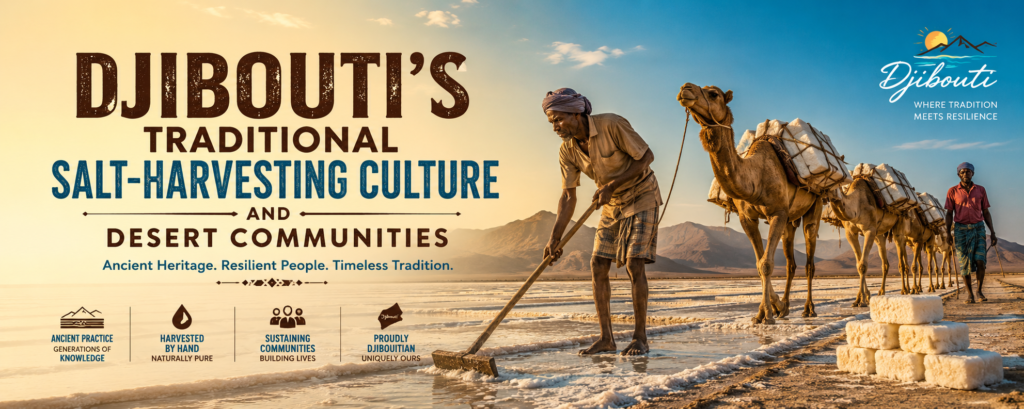
Beyond its sparkling coastline, this compact nation features otherworldly landscapes, most notably Lake Assal. Sitting deep in the Danakil Depression, this crater lake is surrounded by a dazzling white crust of salt that glimmers under the desert sun. For generations, this harsh environment has been home to resilient desert communities whose lives are deeply intertwined with the ancient art of salt harvesting.
If you are looking to step off the beaten path and witness a way of life that has survived for centuries, Djibouti’s salt plains belong at the very top of your bucket list.
The Marvel of Lake Assal: Africa’s Lowest Point
To understand Djibouti’s salt culture, you first have to understand the landscape. Lake Assal sits at $155$ meters below sea level, making it the lowest point in Africa. Because of extreme evaporation and intense desert heat, the water here is nearly ten times saltier than the ocean.
Over thousands of years, this high salinity has created a thick, blindingly white shoreline of pure salt crystals. Walking along the edge of Lake Assal feels less like visiting a normal lake and more like landing on an alien planet. The contrast between the jet-black volcanic hills, the sapphire-blue water, and the snowy-white salt flats creates a photographer’s dream.
The Afar People: Guardians of the White Gold
The true heartbeat of this region is the Afar people, a nomadic pastoralist group who have adapted to one of the most punishing climates on Earth. For centuries, Afar salt miners have braved blistering temperatures—often exceeding 50^C} (122^F)—to extract salt from the lake bed.
Historically, this salt was known as “white gold.” It served not only as a vital dietary mineral and food preservative but also as a form of currency traded across ancient caravan routes stretching deep into the Horn of Africa.
Today, traditional miners still wade into the shallow brine using long poles and heavy iron bars to break apart thick salt blocks from the lake floor. Watching them work is a humbling reminder of human endurance, skill, and deep cultural heritage.
Traveling Responsibly: What to Expect on Your Journey
Visiting Lake Assal and the surrounding desert communities is an unforgettable experience, but it requires preparation. Before you book your flight to witness these shimmering salt flats and explore Lake Abbe’s towering limestone chimneys, you will want to ensure your paperwork is in order. To get started quickly, you can complete your Djibouti Visa Application online in just a few minutes with a simplified form.
Here are a few quick tips for planning your trip once you arrive:
-
Timing is Everything: Plan your visit during the cooler winter months (November to February) when daytime temperatures are more manageable for exploring the desert.
-
Protect Yourself: Bring plenty of drinking water, heavy-duty sunscreen, sunglasses to protect against the glaring white reflection, and sturdy footwear.
-
Engage Respectfully: Always travel with a local guide who can introduce you to community members respectfully, ensuring your visit honors their traditions and daily lives.
Why Choose Our Travel Services?
Planning an international trip to East Africa should feel exciting, not stressful. When you are ready to experience the wonders of Djibouti, making sure your travel preparations are handled smoothly and securely lets you focus entirely on the adventure ahead. Here is how we support your journey:
-
Reliable Travel Visa Services: Our global approach has assisted numerous travelers in obtaining their Visa.
-
Round-the-Clock Assistance: Reach out to us $24/7$, and our experts will respond within $72$ hours to keep your plans on track.
-
Experienced Visa Consultants: Receive expert guidance to ensure the accuracy and acceptance of your application.
-
Efficient Visa Application Process: Apply for your Djibouti Visa Application in minutes with our simplified form.
Conclusion
Djibouti’s traditional salt-harvesting culture is a powerful testament to human resilience and ancient traditions surviving in a modern world. By stepping into the heart of the Danakil Depression, you aren’t just sightseeing—you are bearing witness to a timeless way of life. Pack your sense of wonder, prepare for an epic desert journey, and discover the hidden soul of Djibouti.