When most people think of a classic tropical adventure, the Amazon often comes to mind first. But for those looking for something truly raw, untouched, and incredibly wild, the Congo Rainforest is the ultimate frontier. Spanning over 1.78 *10 km, the Congo Basin is the second-largest rainforest on Earth. It is a place of deep green canopies, massive winding rivers, and rare wildlife that you cannot find anywhere else in the world.
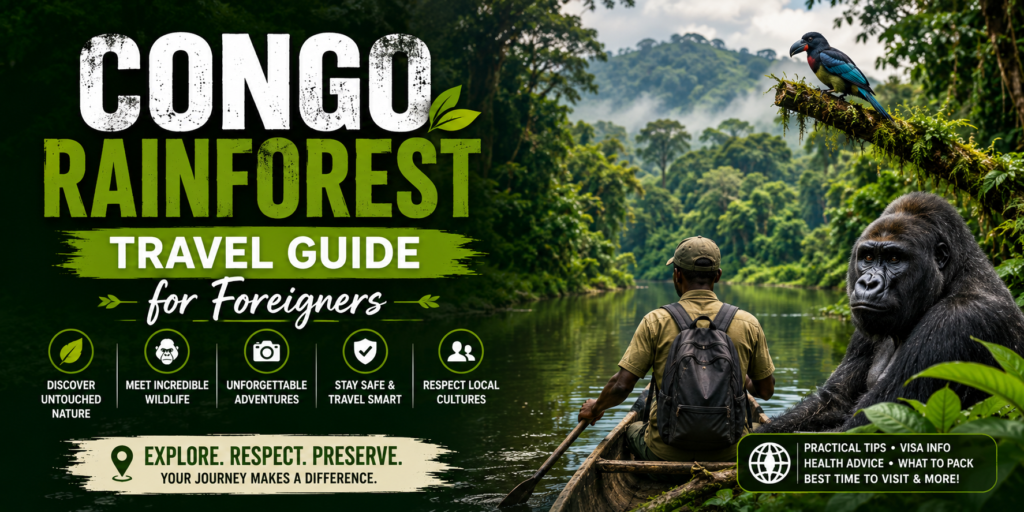
However, traveling here is not like booking a weekend getaway to Bali or Costa Rica. It requires careful planning, a bit of grit, and the right paperwork.
If you are a foreigner dreaming of exploring this magnificent ecological wonder, this complete, step-by-step travel guide will answer all of your burning questions.
1. What exactly is the Congo Rainforest?
The Congo Rainforest is the beating heart of Central Africa. Fed by the massive Congo River (the second-longest river in Africa and the deepest river in the world), this jungle is so dense and vast that it acts as one of the Earth’s primary lungs. In fact, scientists have found that its carbon sequestration capabilities are up to six times stronger than those of the Amazon.
It is a sanctuary of biodiversity, home to over 10,000 animal species and thousands of unique tropical trees. The trees here grow taller and are more spread out than those in other major rainforests, creating a massive, cathedral-like canopy that shelters rare and beautiful creatures.
2. Which country should I visit to see the Congo Rainforest?
While the Congo Basin spans six countries—Cameroon, the Central African Republic, the Republic of the Congo, the Democratic Republic of the Congo (DRC), Equatorial Guinea, and Gabon—most tourists focus their travels on two main nations:
-
The Democratic Republic of the Congo (DRC / Congo-Kinshasa): This is where you go for dramatic adventures like trekking to see mountain gorillas in Virunga National Park or hiking active volcanoes.
-
The Republic of the Congo (Congo-Brazzaville): This country offers a more peaceful, low-key eco-tourism experience, famous for lowland gorilla tracking in Odzala-Kokoua National Park.
For the ultimate raw adventure, the Democratic Republic of the Congo (DRC) is the top choice for travelers seeking major wildlife encounters.
3. Is it safe for foreigners to travel to the Congo Rainforest?
This is the number one question on every traveler’s mind. The short answer is: Yes, but only if you travel with a registered tour operator and stick to designated tourist zones.
Certain areas, particularly in the eastern parts of the DRC near the borders, have experienced political instability and conflict over the years. However, national parks like Virunga and Kahuzi-Biega have their own highly trained rangers who work tirelessly to keep tourist routes secure.
To stay safe:
-
Never attempt to backpack through the jungle solo.
-
Always book your trip through a reputable safari agency or directly through the official national park authorities.
-
Keep an eye on your home country’s travel advisories, and always hire local guides who know the current ground reality.
4. How do I get a tourist visa for the Democratic Republic of Congo (DRC)?
To enter the DRC, almost all foreign nationals must secure a visa before arrival. In the past, this was a stressful, paper-heavy process that involved mailing your actual passport to an embassy. Fortunately, the process has become much easier with the introduction of the electronic visa (eVisa).
If you are looking for a stress-free way to secure your travel authorization, you can apply through a specialized visa agency to ensure your application is filled out correctly.
Why choose us for your DRC Visa?
If you are planning your adventure, we can handle the hard work behind the scenes. Here is why travelers trust us:
-
Reliable Travel Visa Services: Our global approach has assisted numerous travelers in obtaining their visas smoothly.
-
Round-the-Clock Assistance: Reach out to us 24/7, and our experts will respond to your queries within 72 hours.
-
Experienced Visa Consultants: Receive expert guidance to ensure the acceptance of your application.
-
Efficient Visa Application Process: Apply for your visa in minutes with our simplified online form.
Ready to secure your travel documents? Get your official DRC Tourist Visa and start planning your bucket-list journey today.
5. What vaccinations do I need to enter the Congo?
Do not leave home without checking your medical list. The immigration officers at the airport will strictly inspect your health documents.
-
Yellow Fever Certificate: This is absolutely mandatory. You must receive your Yellow Fever vaccine at least 10 days before arriving and carry the physical yellow card with you.
-
Polio Vaccine: Depending on your country of origin and current outbreaks, proof of a polio booster may be required.
-
Malaria Prophylaxis: The Congo Basin is a high-risk malaria zone. Talk to a travel doctor about taking preventative pills (like Malarone or Doxycycline).
-
Routine Shots: Make sure your Hepatitis A, Hepatitis B, Typhoid, and Tetanus vaccinations are completely up-to-date.
6. What is the best time of year to plan my visit?
Because the Congo is situated right on the equator, it is warm and humid year-round, with average temperatures hovering around $25^\circ\text{C}$ to $30^\circ\text{C}$ ($77^\circ\text{F}$ to $86^\circ\text{F}$).
However, the region experiences two main seasons:
-
The Dry Seasons (June to August & January to February): This is generally considered the best time for trekking. The forest floor is less muddy, hiking trails are easier to navigate, and mosquitoes are slightly less active.
-
The Wet Seasons (March to May & September to November): While hiking in heavy rain can be challenging, the wet season is actually great for spotting wildlife. Many trees bear fruit during this time, drawing gorillas and forest elephants down to lower ground to feed.
7. Can I see mountain gorillas and lowland gorillas there?
Yes! The Congo Basin is one of the only places on Earth where you can see both of these incredible primate species:
-
Mountain Gorillas: Found in the high-altitude forests of Virunga National Park (DRC). Tracking them involves hiking through misty, volcanic slopes.
-
Eastern Lowland Gorillas: Found in Kahuzi-Biega National Park (DRC). These gorillas are larger than mountain gorillas and live in lower-altitude tropical forests.
-
Western Lowland Gorillas: Found in Odzala-Kokoua National Park (Republic of the Congo).
Remember, you must purchase a gorilla tracking permit in advance. These permits are strictly limited to protect the animals from human stress and disease transmission.
8. How do I hike the famous Nyiragongo active volcano?
Mount Nyiragongo, located inside Virunga National Park, is home to one of the world’s largest active lava lakes. Hiking to the summit is a legendary adventure.
-
The Trek: It is a steep, demanding 4-to-6-hour climb starting at $2,000 \text{ meters}$ and topping out at $3,470 \text{ meters}$ above sea level. You need a good level of physical fitness.
-
The Summit: Once you reach the top, you spend the night in basic wooden shelters right on the crater rim. Watching the giant lake of bubbling, red-hot lava glow in the dark is an experience you will never forget.
-
What to Pack: The summit gets incredibly cold and windy at night (sometimes dropping close to freezing). Bring warm layers, thermal underwear, a rain jacket, and sturdy hiking boots.
(Note: Always check the active status of the volcano and park safety updates before booking, as geological activity can affect trail availability.)
9. What unique wildlife can I spot in the Congo Basin?
Aside from gorillas, the Congo Rainforest is home to several highly specialized species that you cannot see in the savannas of East Africa:
-
The Okapi: Often called the “forest giraffe,” this beautiful animal looks like a mix between a zebra and a horse but is actually the only living relative of the giraffe.
-
Forest Elephants: Smaller than their savanna cousins, these elephants have straighter, downward-pointing tusks that help them move easily through the dense jungle brush.
-
Bonobos: Our closest living genetic relatives, these highly intelligent and peaceful apes are endemic strictly to the lowland forests of the DRC.
-
Pangolins, Forest Buffalos, and Rare Birds: The forest floor and rivers are alive with incredible biodiversity, making it a dream destination for avid birdwatchers and wildlife photographers.
10. What are the best national parks to visit?
When planning your itinerary, focus on these top-tier protected areas:
-
Virunga National Park (DRC): Africa’s oldest national park. It offers mountain gorilla trekking, chimpanzee walks, and the Nyiragongo volcano hike.
-
Kahuzi-Biega National Park (DRC): A UNESCO World Heritage site and the primary sanctuary for Eastern Lowland gorillas.
-
Odzala-Kokoua National Park (Republic of Congo): Famous for luxury eco-lodges, pristine lowland forest canopy walks, and tracking western lowland gorillas.
-
Dzanga-Sangha Protected Areas (Central African Republic): Renowned for “Dzanga Bai,” a large forest clearing where hundreds of forest elephants gather to lick minerals from the mud.
11. What should I pack for a deep rainforest expedition?
Packing the right gear can make or break your trip to a humid, muddy jungle. Here are the essentials:
-
Sturdy, Waterproof Hiking Boots: Make sure they are broken in before you arrive to avoid painful blisters.
-
Lightweight, Long-Sleeved Clothing: Choose moisture-wicking fabrics. Long sleeves and pants are vital to protect you from thorns, stinging nettles, and biting insects (like tsetse flies).
-
High-Quality Rain Gear: A lightweight, breathable waterproof jacket is a must.
-
Gaiters and Gardening Gloves: Gaiters prevent ants and mud from slipping into your boots. Heavy-duty gloves are incredibly useful for gripping thorny branches during steep gorilla climbs.
-
Insect Repellent: Use a high-concentration DEET or Picaridin spray.
-
Waterproof Dry Bags: Essential for keeping your camera gear, passport, and electronics dry during sudden downpours.
12. What are the local customs and etiquette rules I should know?
Respecting the local culture will ensure you have a warm, welcoming experience:
-
Always Ask Before Taking Photos: Taking photos of locals, police officers, military checkpoints, or government buildings without permission is highly offensive and can get you into trouble with authorities.
-
Greetings Matter: Take the time to greet people with a polite handshake and a smile. Learning a few words in French (the official language) or Lingala/Swahili goes a long way.
-
Tipping Culture: Tipping is highly appreciated. Keep a stack of small, clean US dollar bills handy for guides, drivers, and trackers.
-
Carry Cash: The Congolese economy runs on cash. Most places do not accept credit cards, and ATMs are scarce outside of major cities like Kinshasa or Goma. Crucial tip: Bring US dollar bills printed after 2013 that are completely clean, untorn, and unmarked; otherwise, banks and shops will refuse to accept them.
13. Is there internet connection or electricity inside the camps?
Do not expect to stream movies or hop on Zoom calls in the deep jungle. Most jungle lodges and conservation camps rely entirely on solar power or generators. Electricity is usually only available during specific hours of the day (usually in the mornings and evenings) to charge your cameras and phones.
Wi-Fi is either extremely limited or non-existent once you leave major hubs. If you need connection, you can purchase a local SIM card (such as Airtel or Vodacom) in cities like Kinshasa or Goma, but service will disappear entirely once you head deep into the national parks. Embrace the opportunity to completely unplug!
14. How much does a Congo rainforest trip cost?
A trip to the Congo rainforest is generally expensive. Because of the lack of public infrastructure, you cannot easily travel “on a budget.”
-
Gorilla Permits: Can range from $400 to $600+ USD depending on the park and season.
-
Logistics: You will need private 4×4 vehicles, local drivers, park rangers, and sometimes domestic charter flights to get between remote airstrips.
-
Lodging: Eco-lodges range from basic park cabins to high-end luxury camps (which can cost over $1,000 USD per night, including meals and activities).
While it is a significant financial investment, the money you spend goes directly toward supporting local community employment and vital wildlife conservation efforts that protect this fragile ecosystem.
Final Thoughts: Are You Ready for the Congo?
A trip to the Congo Rainforest is not for the faint of heart. It is unpredictable, physically demanding, and requires patience. But for those willing to step outside their comfort zones, it offers an untamed beauty, vibrant cultures, and wild wildlife encounters that no other place on earth can match.
Make sure your passport is ready, get your health checks sorted, and let us handle your visa paperwork so you can focus entirely on the adventure of a lifetime!