
Opening a bakery sounds exciting… until you start thinking about the cost of making everything fresh every single day. But what if baking from scratch isn’t the only way to run a successful bakery?
For bakery owners, café operators, and pastry businesses, the choice between fresh production, frozen dough systems, and par-baked products has become about much more than baking. It’s a strategic business decision that can influence everything from staffing and sourcing baking supplies to product consistency and customer satisfaction
Each approach comes with its own advantages and trade-offs. The right choice can streamline operations, reduce waste, maintain quality, and support long-term growth.
In this article, we’ll break down how these systems work so you can make confident decisions for your business—whether you’re opening a new location, expanding your menu, or simply looking to improve efficiency.
1. Fresh (Made-from-Scratch, In-House Production)

Fresh bakery production means everything is made in-store from raw ingredients: mixing, proofing, shaping, and baking all happen on-site.
How it works
In a fresh production system, bakers begin with raw ingredients and baking supplies such as flour, yeast, sugar, butter, and dairy, which are mixed into doughs or batters in-house. The dough is then fermented and proofed under controlled conditions, shaped into its final form, and baked entirely on-site.
Every stage of production, from mixing to baking, is completed within the bakery, typically following a daily production schedule to ensure products are served at peak freshness.
Advantages
-
Full control over recipes, ingredients, and production methods
-
Strong artisan or premium brand positioning
-
High level of customization in flavor and product design
-
Fresh aroma and texture directly from the oven
Disadvantages
-
High labor requirements and need for skilled staff
-
Time-intensive and operationally complex production
-
Short shelf life leading to higher waste risk
-
Greater investment in equipment and training
Best suited for
-
Artisan bakeries
-
High-end pastry shops
-
Businesses with strong culinary branding
2. Frozen Dough (Raw or Ready-to-Bake)
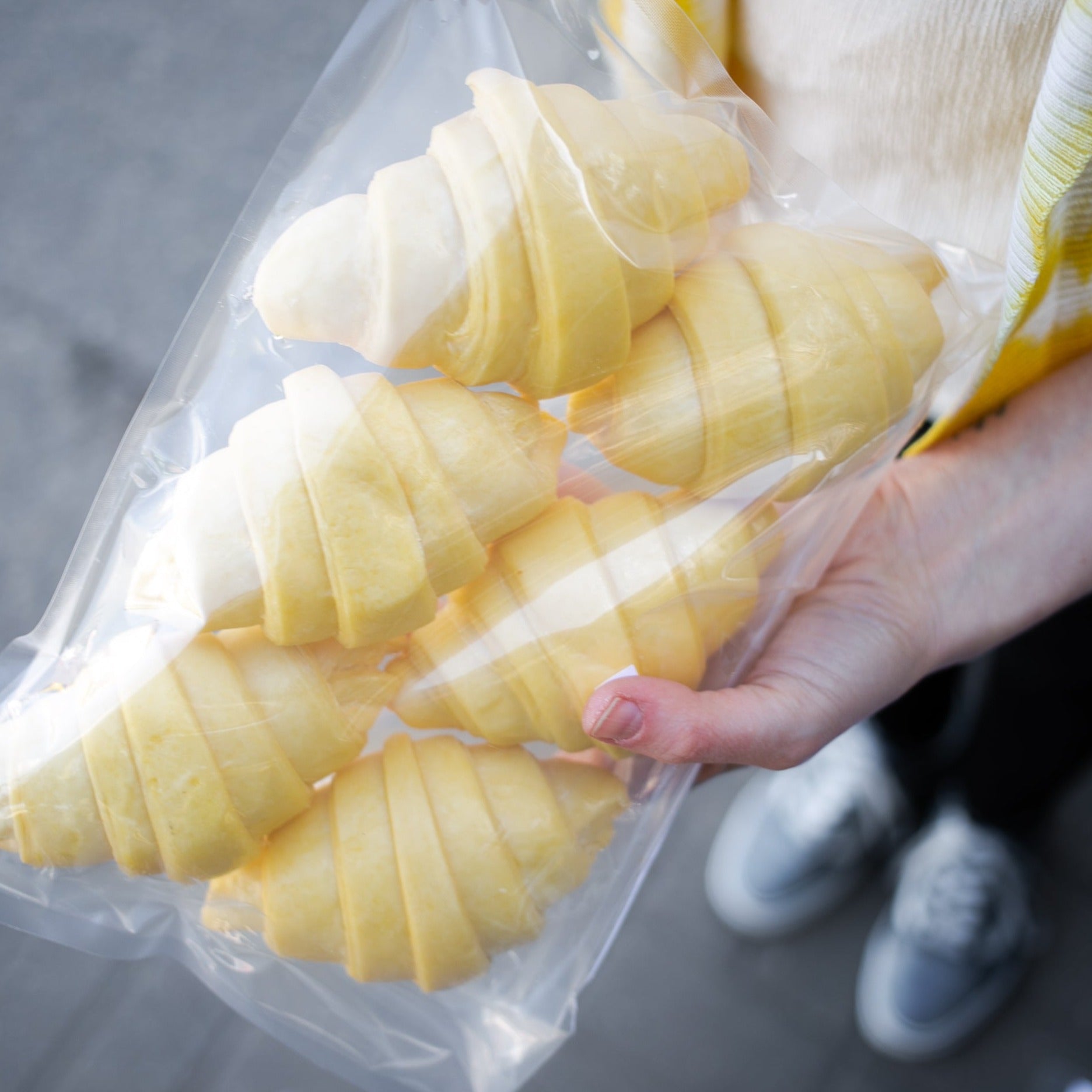
Frozen dough systems include both raw frozen dough and ready-to-bake frozen dough. These products are prepared at a central facility, frozen for storage, and then finished in-store.
How it works
In frozen dough systems, production takes place at a centralized facility where dough is mixed, shaped, and frozen either in a raw state or after partial preparation.
Raw frozen dough must be thawed, proofed, and then baked in-store before serving. Ready-to-bake frozen dough is more advanced and can often be placed directly into the oven with minimal preparation, requiring only baking time to complete the process. In both cases, most of the production work is completed before the product arrives at the bakery or café.
Advantages
-
Improved operational efficiency and reduced in-store labor
-
Consistent product quality across batches and locations
-
Longer shelf life and better inventory control
-
Easier training and simpler production workflows
Disadvantages
-
Limited control over formulation and production process
-
Requires freezer storage and cold-chain management
-
Slight reduction in artisanal texture in some products
-
Higher unit cost compared to raw ingredient baking
Best suited for
-
Coffee shops and cafés
-
Franchise chains
-
Hotels and convenience-focused operations
3. Par-Baked Products (80–90% Baked, Then Frozen)
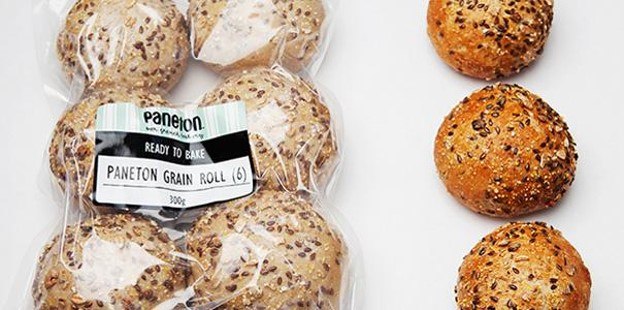
Par-baked products are partially baked at the manufacturer—typically around 80–90% completion—then frozen and shipped for final baking in-store.
How it works
In a par-baked system, dough is first mixed, shaped, and baked at a production facility until it reaches approximately 80–90% completion. The product is then rapidly cooled, frozen, and distributed to bakeries or cafés.
Once received, staff simply place the product in the oven for a short finishing bake. This final step completes the baking process, allowing the product to develop its crust, aroma, and final texture in-store, creating a “freshly baked” experience with minimal preparation.
Advantages
-
Very low in-store labor requirements
-
Strong consistency and reliable product quality
-
Fresh-baked experience with minimal effort
-
Reduced waste through on-demand finishing
-
High efficiency for peak-hour service
Disadvantages
-
Limited flexibility and customization in-store
-
Dependent on supplier quality and specifications
-
Requires precise oven timing and handling
-
Less artisanal control compared to fresh baking
Best suited for
-
Busy cafés and coffee chains
-
Quick-service restaurants
-
Hotels with breakfast service
-
High-volume retail bakeries
Key Differences at a Glance
Hybrid Strategy: Using All Three Systems Together
Most modern bakery and café operations do not rely on just one method. Instead, they combine fresh, frozen dough, and par-baked products strategically.
Best products for fresh production
-
Signature cakes and desserts
-
Specialty pastries
-
Seasonal or limited-edition items
-
High-margin artisan breads
Best products for frozen dough systems
-
Cookies
-
Muffins
-
Standard sandwich bread
-
Croissants (for consistency-focused businesses)
Best products for par-baked systems
-
Baguettes and artisan rolls
-
Breakfast pastries in cafés
-
High-volume bread service items
-
Grab-and-go baked goods
This hybrid approach allows businesses to maximize labor efficiency, maintain brand differentiation, reduce waste, and offer a wider product range without overloading production capacity.
Which Model Is Right for Your Business?

1. Artisan Bakery Model
If your brand is built on craftsmanship and uniqueness, fresh production should dominate. Frozen or par-baked items may play a small supporting role for efficiency.
2. Café / Coffee Shop Model
If baked goods support beverage sales, par-baked and frozen dough systems make the most sense, with limited fresh items for differentiation.
3. Franchise or Chain Model
Consistency is key. Frozen dough and par-baked systems ensure uniformity across locations, reducing operational risk.
4. High-Volume Hospitality (Hotels, Catering)
Efficiency, speed, and predictability matter most. Par-baked products are often the most practical core system, supplemented by select fresh items.
The Recipe for a Balanced Bakery Business
There’s no single “best” system—only what fits your business. Fresh baking brings character and craftsmanship, frozen dough makes day-to-day operations more efficient and scalable, and par-baked products deliver that fresh-baked experience with minimal effort.
For most bakeries and cafés, success comes from balance: staying profitable, keeping quality consistent, and making sure every customer leaves happy with what they taste.
Author Bio: Carmina Natividad is a resident writer for Mauri, a trusted name in baking supplies and ingredients across Australia and New Zealand. She enjoys sharing practical insights and inspiration to help bakers, from local artisans to large-scale producers, create consistently high-quality, delicious baked goods.