Are you looking for your next big adventure? If you want a destination that blends ultra-modern cities, ancient temples, breathtaking mountains, and mouthwatering street food, look no further than Taiwan. This beautiful island nation is quickly rising to the top of every traveler’s bucket list.
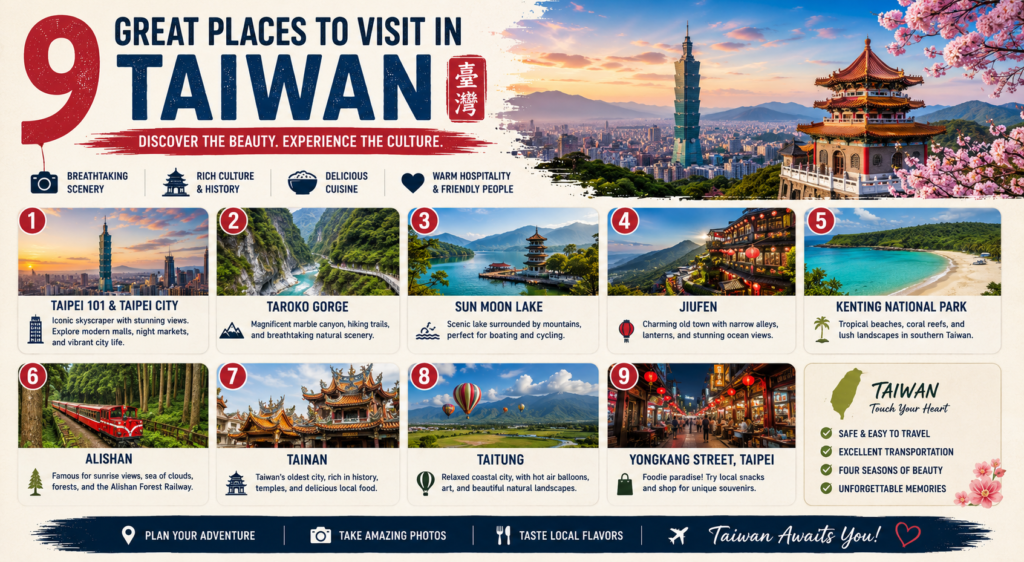
In this comprehensive guide, we will explore nine of the most incredible places to visit in Taiwan, answer your most pressing travel questions, and show you how to prepare for an unforgettable trip.
1. Why is Taiwan becoming Asia’s must-visit travel destination?
For a long time, Taiwan was a hidden gem overshadowed by its larger neighbors. Today, the secret is out. Travelers from all over the world are realizing that this small island pack a massive punch.
What makes Taiwan so special is its sheer variety. Within a single day, you can go from sipping artisan coffee in a sleek skyscraper in Taipei to hiking through lush subtropical forests or relaxing on a golden beach in the south. On top of that, Taiwan is consistently ranked as one of the safest and friendliest countries in the world. The locals are exceptionally welcoming, the public transit is world-class, and the food scene is legendary.
2. What is the best time of year to visit Taiwan?
Planning when to visit is crucial for getting the most out of your trip.
-
Autumn (October to December): This is widely considered the absolute best time to visit Taiwan. The weather is comfortably cool, humidity is low, and rainfall is minimal. It is perfect for walking tours and hiking.
-
Spring (March to May): Another fantastic window. The temperatures are mild, and you can catch beautiful cherry blossoms blooming in the mountain regions like Alishan.
-
Winter (January to February): Great if you love hot springs. While northern Taiwan (including Taipei) gets cloudy and damp, southern Taiwan remains relatively dry and warm.
-
Summer (June to September): Summer is hot, humid, and marks the peak of the typhoon season. If you visit now, expect heavy afternoon downpours but enjoy fewer crowds at popular indoor spots.
3. Do you need a tourist visa to visit Taiwan?
Before booking your flights, you need to check the entry requirements. Citizens of many countries, including the US, Canada, the UK, Australia, New Zealand, and most EU nations, enjoy visa-free entry for tourist stays ranging from 14 to 90 days.
However, if your nationality is not on the visa-free list, or if you plan to stay longer, you will need to apply for a tourist visa or an electronic visa (e-Visa) before your departure. It is highly recommended to sort this out at least a few weeks in advance to avoid any stressful last-minute delays at the airport.
4. How do you easily apply for a Taiwan e-Visa online?
If you require a visa to enter Taiwan, the process doesn’t have to be complicated. You can skip the long queues and embassy appointments by using a reliable online visa service.
We highly recommend checking out Taiwan e-Visa Tourism Services to streamline your application.
Why Choose This Service?
-
Reliable Travel Visa Services: Their global, professional approach has successfully assisted thousands of international travelers in securing their official entry travel documents.
-
Round-the-Clock Assistance: Travel plans don’t stick to a 9-to-5 schedule. You can reach out to their support team 24/7, and their visa experts will respond with helpful guidance within 72 hours.
-
Experienced Visa Consultants: Get personalized, expert reviews of your documents to ensure your application meets all government standards and is accepted without delay.
-
Efficient Visa Application Process: Instead of navigating confusing official portals, you can apply for your visa in just a few minutes using a highly simplified, user-friendly digital form.
5. What are the top 9 must-visit attractions in Taiwan?
Taiwan is filled to the brim with scenic views and cultural wonders. To help you plan your itinerary, here are the nine best places you absolutely cannot miss on your trip.
6. Why is Taipei 101 more than just a giant skyscraper?
Dominating the skyline of the capital city, Taipei 101 was once the tallest building in the world (from 2004 to 2010). Shaped like a giant, modern bamboo stalk, this architectural marvel is a symbol of Taiwan’s technological rise.
But it’s much more than just a pretty building to photograph from the ground. Inside, you can ride one of the world’s fastest double-deck elevators, which whisks you up to the 89th-floor indoor observatory in just 37 seconds! From the top, you get a stunning 360-degree view of the entire Taipei basin. Make sure to visit the massive, gold-colored steel pendulum suspended inside the building—this 660-metric-ton wind damper keeps the tower stable during typhoons and earthquakes.
7. Is Jiufen Old Street really the inspiration for “Spirited Away”?
Perched on a steep mountainside overlooking the Pacific Ocean, Jiufen is a charming, historic gold-mining town. Walking through its narrow, winding cobblestone alleys feels like stepping back in time.
Many travelers point out its striking resemblance to the magical spirit world in Studio Ghibli’s animated masterpiece, Spirited Away. Even though the director has never officially confirmed this, the glowing red lanterns, traditional teahouses, and misty atmosphere make it feel incredibly mystical. Be sure to stop by the famous A-Mei Tea House for a traditional tea ceremony and enjoy the sweeping coastal views.
8. How can you explore the stunning marble cliffs of Taroko Gorge?
Located on the scenic east coast in Hualien, Taroko Gorge is Taiwan’s premier natural wonder. It is a massive, 19-kilometer-long canyon carved out of solid marble by the rushing waters of the Liwu River.
As you walk along the carved-out cliffside trails, you will be surrounded by towering, vertical white marble walls, cascading waterfalls, and deep emerald pools. Note for travelers: While the area is breathtaking, a major earthquake in early 2024 caused significant damage to some trails in Taroko National Park. Repair works are ongoing, so always check the official national park website before visiting to see which trails are open and safe for hiking.
9. Why is Sun Moon Lake considered Taiwan’s most romantic escape?
Nestled in the quiet, mountainous heart of Nantou County, Sun Moon Lake is the largest natural body of water in Taiwan. The lake gets its poetic name because its eastern side is shaped like the sun, while the western side resembles a crescent moon.
The best way to experience the tranquil beauty of the lake is to rent a bicycle. The pathway circling the lake is widely regarded as one of the most beautiful cycling routes in the world. You can also take a leisurely boat cruise across the misty water, visit the majestic Wenwu Temple, or take the ropeway cable car up to enjoy a bird’s-eye view of the entire valley.
10. What makes the Alishan Forest Railway a magical mountain experience?
For nature lovers, Alishan National Scenic Area is a paradise of ancient giant cypress trees, rolling tea plantations, and sea-of-clouds vistas. But the highlight of any trip to Alishan is riding the historic Alishan Forest Railway.
Built by the Japanese in 1912 to transport timber, this narrow-gauge railway climbs up steep mountain slopes, passing through dense green forests, dark tunnels, and wooden bridges. Travelers wake up before dawn to take the train up to Chushan Station to witness Alishan’s legendary sunrise, where the sun rises over a literal ocean of fluffy white clouds.
11. Where can you find the best street food in Taiwan?
No trip to Taiwan is complete without diving headfirst into its world-famous night market culture.
-
Shilin Night Market (Taipei): This is the largest and most famous night market in the capital. It is a labyrinth of food stalls serving up classic Taiwanese staples like crispy giant fried chicken cutlets, oyster omelets, bubble milk tea, and the infamous stinky tofu.
-
Liuhe Night Market (Kaohsiung): Located in the south, this market is celebrated for its incredible seafood. Try the grilled squid, fresh crab claws, and the sweet, refreshing papaya milk.
Visiting these markets is as much about the lively, bustling atmosphere as it is about the delicious, affordable food.
12. What can you see at the colorful Lotus Pond in Kaohsiung?
Located in Taiwan’s southern maritime city of Kaohsiung, Lotus Pond is a beautiful artificial lake surrounded by dozens of vibrant temples, pavilions, and shrines.
The main attraction here is the iconic Dragon and Tiger Pagodas. Visitors enter the twin towers through the open mouth of a giant dragon and exit through the mouth of a roaring tiger. According to local Taoist tradition, walking through the pagodas this way symbolizes turning bad luck into good fortune.
13. Is Kenting National Park really the “Hawaii of Taiwan”?
If you are looking for sun, sand, and surf, head to the southernmost tip of the island to Kenting National Park. With its tropical climate, waving palm trees, and vibrant coral reefs, it is easy to see why locals call it the “Hawaii of Taiwan.”
Kenting offers a beautiful, laid-back coastal escape. You can spend your days sunbathing on the white sands of Baisha Bay, renting a scooter to explore the dramatic coastal rock formations, or snorkeling among colorful marine life. At night, Kenting Main Road transforms into a lively night market filled with tropical cocktails and fresh street food.
14. Why is the otherworldly landscape of Yehliu Geopark a must-see?
Located on a narrow peninsula on Taiwan’s northern coast, Yehliu Geopark looks like a scene straight out of a science-fiction movie. Over thousands of years, wind and ocean erosion have carved the soft limestone rocks into strange, mushroom-like shapes.
The most famous rock formation in the park is the “Queen’s Head,” which bears an uncanny resemblance to the profile of a royal queen. Because of ongoing natural erosion, the queen’s “neck” is getting thinner every year, making it an urgent must-visit before this natural masterpiece eventually collapses.
15. How many days do you need to properly travel around Taiwan?
Because Taiwan is relatively compact and connected by high-speed trains, you can see a lot of the island even on a short trip.
-
5 to 7 Days: Perfect for exploring the highlights of Taipei, taking a day trip to Jiufen and Yehliu, and visiting either Sun Moon Lake or Taroko Gorge.
-
10 to 14 Days: This is the ideal duration for a full “round-the-island” loop. It allows you to take your time exploring Taipei, Taichung, Alishan, Tainan, Kaohsiung, and the scenic east coast of Taitung and Hualien without feeling rushed.
16. How do you travel easily within Taiwan using an EasyCard?
One of the best things about traveling in Taiwan is how simple it is to get around. As soon as you arrive at the airport, purchase a reloadable smart card called an EasyCard (or iPass).
You can tap this card to ride the ultra-clean MRT subways in Taipei and Kaohsiung, hop on local city buses, rent public U-bicycles, and even pay for train rides. Even better, you can use your EasyCard to buy snacks, drinks, and essentials at any of Taiwan’s thousands of convenience stores (like 7-Eleven and FamilyMart), making cash-free travel incredibly convenient!