When most people think of traveling to the Middle East, they picture hyper-modern glass skyscrapers rising from the sand, or vast, unreachable deserts. But there is a country on the southeastern tip of the Arabian Peninsula that offers something completely different.
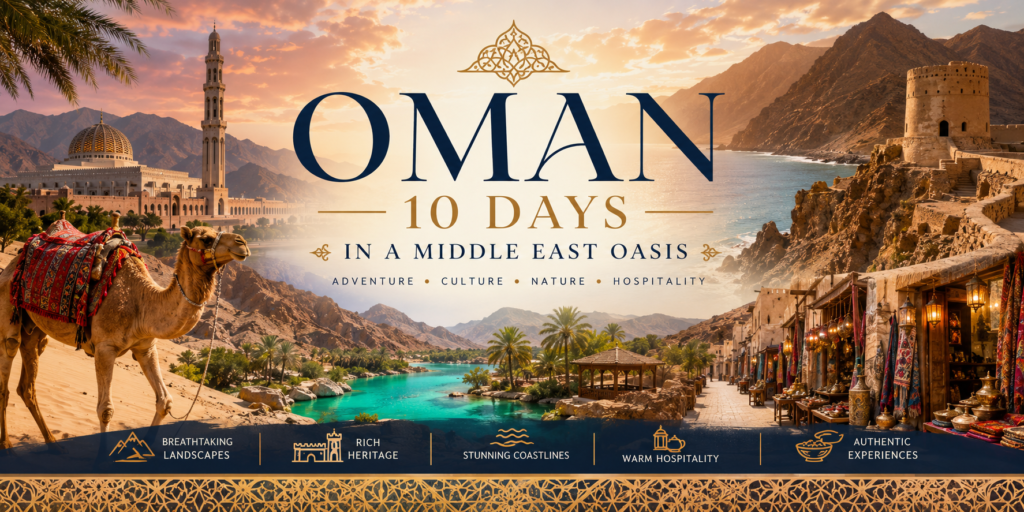
Oman is a land of dramatic contrast. Here, you will find jagged mountain ranges that plunge directly into turquoise seas, emerald-green mountain pools hidden inside limestone canyons, rolling orange desert dunes, and a ancient heritage that is protected with deep pride. It is a peaceful, welcoming oasis that remains one of the travel world’s best-kept secrets.
If you are planning an adventure here, a 10-day road trip is the perfect amount of time to experience the country’s highlights. Below, we break down everything you need to know to plan your dream trip to Oman.
Why is Oman considered the hidden oasis of the Middle East?
Unlike some of its neighbors, Oman has chosen to preserve its traditional architectural heritage rather than build towering skyscrapers. By law, buildings must retain traditional Omani style, featuring white or cream-colored facades, dome arches, and elegant minarets.
Oman is called an oasis because of its incredible geographical diversity. Within a few hours of driving, you can go from a dry, sun-baked desert to a cool mountain peak where pomegranates and roses grow on terraced gardens, or find yourself swimming in a crystal-clear natural pool fed by a freshwater mountain spring. Above all, the warmth and genuine hospitality of the Omani people make the entire country feel like a safe, peaceful refuge.
Is Oman safe for foreign tourists and solo travelers?
Yes, Oman is consistently rated as one of the safest countries in the entire world. The crime rate is exceptionally low, and violent crime against tourists is virtually non-existent.
Omanis are incredibly respectful, polite, and welcoming. If you are a solo traveler or a female traveler, you can explore the cities, markets, and natural attractions with a peace of mind that is rare in many global destinations. While it is always smart to practice standard travel safety—such as securing your vehicle and not camping in completely isolated areas alone at night—you will generally find that locals are more likely to offer you help, directions, or a warm cup of coffee than cause any trouble.
What is the best time of year to visit Oman?
The absolute best time of year to visit Oman is between late October and mid-March. During these winter months, the daytime temperatures are incredibly comfortable, hovering between 20°C and 30°C (68°F to 86°F). This is the perfect weather for hiking through canyons, camping in the desert, and exploring the cities.
If you travel during the summer months (June to August), the heat in most of the country becomes extreme, often exceeding 45°C (113°F). However, there is a fascinating exception: the southern coastal city of Salalah experiences a unique monsoon season called the Khareef from June to September. This monsoon turns the dry desert landscape of the south into a lush, misty green paradise, attracting many regional visitors.
How many days should you spend in Oman?
While you can see Muscat and a nearby canyon in a long weekend, 10 days is the absolute sweet spot for a first-time trip to Oman.
Ten days gives you enough time to experience the capital city of Muscat, swim in the famous coastal wadis, watch sea turtles nest on the beach, sleep under the stars in a desert camp, explore ancient mountain forts, and hike along the rim of Oman’s “Grand Canyon.” Because the roads in Oman are in pristine condition, a 10-day self-drive itinerary allows you to travel at a relaxed pace without feeling rushed.
Do I need a visa to visit Oman?
Most international travelers require a visa to enter the Sultanate of Oman. However, there is great news for short-term visitors: citizens from over 100 countries are exempt from entry visas for stays of up to 14 days.
To qualify for this 14-day visa exemption, you must hold a passport valid for at least 6 months, have a confirmed return flight ticket, a confirmed hotel booking, and valid travel health insurance that covers your stay.
If you plan to stay longer than 14 days, or if your nationality is not on the exempt list, you must apply for Oman eVisa online before you travel. Applying through a reliable electronic visa service ensures your paperwork is perfectly processed and approved before you board your flight.
What is the ultimate 10-day Oman road trip itinerary?
To get the absolute most out of your trip, we recommend renting a car and following this tried-and-tested 10-day loop starting and ending in Muscat:
-
Day 1: Welcome to Muscat. Land at Muscat International Airport, pick up your rental car, and head to your hotel. In the late afternoon, head to the Mutrah district to walk along the seaside Corniche and explore the historic Mutrah Souq, where the scent of frankincense fills the air.
-
Day 2: The Wonders of Muscat. Spend your morning visiting the majestic Sultan Qaboos Grand Mosque, home to a massive hand-woven Persian carpet and a stunning Swarovski crystal chandelier. Later, photograph the colorful Al Alam Palace and catch a evening performance or take a tour of the Royal Opera House Muscat.
-
Day 3: Bimmah Sinkhole & Wadi Shab. Drive south along the coast. Stop first at Bimmah Sinkhole, a massive natural limestone depression filled with sparkling turquoise water. Next, head to Wadi Shab. Take a short boat ride across the river, then hike for 45 minutes through a dramatic rocky gorge to reach a series of crystal-clear freshwater pools. You can swim through a narrow cave to find a hidden waterfall inside. Drive to the coastal town of Sur for the night.
-
Day 4: Sur and the Green Turtles. In the morning, explore the maritime town of Sur and visit the last remaining traditional dhow (wooden boat) building yard. After sunset, drive to the nearby Ras al Jinz Turtle Reserve. Take a guided night tour onto the beach to witness massive green sea turtles slowly dragging themselves onto the sand to lay their eggs.
-
Day 5: Into the desert at Wahiba Sands. Drive inland toward the golden sands of the Sharqiya (Wahiba) Sands. Deflate your car tires and drive into the towering dunes. Check into a traditional desert camp, enjoy a camel ride at sunset, and spend the night stargazing around a campfire deep in the dunes.
-
Day 6: Wadi Bani Khalid to Nizwa. Leave the desert and head to Wadi Bani Khalid, one of Oman’s most beautiful and accessible wadis. Unlike other wadis, this one has large, deep pools of water surrounded by lush palm trees all year round. After a refreshing swim, drive to the historic inland city of Nizwa.
-
Day 7: Forts and Markets of Nizwa. Spend your morning exploring the Nizwa Souq, famous for its silver jewelry, spices, and fresh dates. If you are there on a Friday morning, you can witness the lively traditional livestock market. Afterward, explore the massive 17th-century Nizwa Fort, climbing to the top of its circular tower for panoramic views of the surrounding date plantations. In the afternoon, explore the old clay ruins of Al Hamra.
-
Day 8: Jebel Shams (The Grand Canyon of Arabia). Drive up into the rugged Hajar Mountains to reach Jebel Shams, the highest peak in Oman. The temperature drops dramatically up here. Hike the famous “Balcony Walk,” an old donkey path carved into the side of a sheer 1,000-meter drop that leads to an abandoned stone village. Sleep in a cozy mountain lodge.
-
Day 9: Jebel Akhdar (The Green Mountain). Drive to the neighboring plateau of Jebel Akhdar. Famous for its terraced agricultural fields, this cool mountain region grows pomegranates, walnuts, and roses. If you visit in March or April, the air is sweet with the scent of blooming roses harvested to make Omani rosewater.
-
Day 10: Return to Muscat & Departure. Drive back down the mountains to Muscat. Do some last-minute shopping for local dates and frankincense, before heading to the airport for your flight home.
What are the clothing and dress code rules in Oman?
Oman is a deeply conservative Muslim country, and respecting the local culture is essential for a smooth trip. While visitors are not expected to wear traditional Omani attire, both men and women should dress modestly in public spaces.
-
For Women: Keep your shoulders and knees covered. Avoid tight, transparent, or low-cut clothing. Maxi dresses, loose trousers, and t-shirts are excellent choices. When visiting the Sultan Qaboos Grand Mosque, women must cover their entire arms and legs down to the ankles, and wear a headscarf (hijab) covering their hair.
-
For Men: Avoid sleeveless tank tops and very short shorts in public. T-shirts and trousers or knee-length shorts are perfect. Full-length pants are required when entering mosques.
Can you swim in Omani wadis, and what should you wear?
Swimming in the wadis is one of the greatest highlights of visiting Oman, but you must respect the local communities that live nearby. Many wadi pools are located near local villages that use the water for drinking and farming.
Because of this, swimming in bikinis, speedos, or tight swimwear is considered highly inappropriate in natural public pools. For women, the best approach is to wear a quick-dry t-shirt and athletic shorts (reaching down to the knees) over your swimsuit. Men should wear swimming trunks or board shorts and a t-shirt. Normal swimwear is perfectly acceptable at private hotel pools and beach resorts in Muscat, but not in the rural wadis.
Do you really need a 4WD car to travel around Oman?
If you plan to stick strictly to Muscat, the coastal highway, and the main cities, a standard sedan is perfectly fine. Oman’s highway network is modern, beautifully paved, and incredibly easy to navigate.
However, if you want to visit the mountains (Jebel Akhdar and Jebel Shams) or drive deep into the Wahiba Sands desert, a 4WD vehicle is mandatory. In fact, there is a police checkpoint at the base of the road leading up to Jebel Akhdar, and officers will not allow you to pass unless you are driving a 4WD. The mountain roads are extremely steep, and having a powerful vehicle with low-range gears is essential for safety when driving back down.
Is English widely spoken in Oman?
Yes, English is very widely spoken throughout Oman. It is taught as a second language in schools and is commonly used in business, tourism, and on road signs, which are written in both Arabic and English.
You will have no trouble communicating in hotels, restaurants, shops, and car rental agencies. However, learning a few basic Arabic phrases is a wonderful way to show respect and will be met with warm smiles by the locals. Simple words like “As-salamu alaykum” (Peace be upon you), “Shukran” (Thank you), and “Marhaba” (Hello) go a very long way.
What traditional Omani food must you try during your trip?
Omani cuisine is a delicious blend of Arabian, Indian, and East African flavors, heavily spiced but generally not fiery hot. Here are the must-try dishes on your trip:
-
Shuwa: This is Oman’s national dish. Meat (usually lamb or goat) is marinated in a rich blend of spices, wrapped in banana or palm leaves, and slow-cooked in an underground clay oven for 24 to 48 hours. The result is incredibly tender, fall-off-the-bone meat served over spiced saffron rice.
-
Kahwa: Omani coffee is a symbol of hospitality. It is a strong, cardamon-infused black coffee served in tiny cups. Because it is bitter, it is always served alongside sweet, fresh Omani dates.
-
Omani Halwa: A sweet, gelatinous dessert made from starch, sugar, saffron, cardamom, rosewater, and ghee, often slow-cooked in large copper pots and sprinkled with nuts.
How expensive is it to travel around Oman?
Oman is generally considered a mid-to-high-range travel destination. The local currency, the Omani Rial (OMR), is one of the strongest currencies in the world, which can make things seem expensive at first glance.
However, you can easily manage your budget. Petrol is incredibly cheap, making road trips affordable. Eating at local “coffee shops” (casual eateries serving delicious South Asian and Middle Eastern wraps, grilled meats, and fresh juices) is very cheap, with meals costing only 1 to 3 OMR ($3 to $8 USD). While high-end luxury resorts in the mountains can be pricey, there are plenty of mid-range hotels, guesthouses, and desert camps that offer incredible value for money.
How do you get an Oman eVisa quickly?
Securing your travel visa is the very first step to ensuring a stress-free journey to this Middle Eastern oasis. Rather than dealing with confusing government portals or risking delays, submitting your Oman visa application online through a specialized service makes the entire process incredibly simple.
Why Choose Us?
-
Reliable Travel Visa Services: Our global approach has assisted numerous travelers in obtaining their visas smoothly and without stress.
-
Round-the-Clock Assistance: Reach out to us 24/7, and our dedicated visa experts will respond to your queries within 72 hours.
-
Experienced Visa Consultants: Receive professional, expert guidance throughout your application to ensure the highest chance of acceptance.
-
Efficient Visa Application Process: Apply for your Oman tourist visa in minutes with our highly simplified online form.
Ready to begin your Arabian adventure? Complete your online Oman eVisa application today!